Creating a Sacred Sound Healing Practice at Home
Why Home Practice Matters
While attending professional sound baths and healing sessions provides powerful experiences, establishing a personal sound practice at home creates consistent, cumulative healing that integrates into your daily life. Just as brushing your teeth maintains oral health, a regular sound practice maintains energetic, emotional, and spiritual wellbeing.
Home practice offers unique advantages: complete freedom to explore at your own pace, the ability to respond to your needs in the moment, no travel time or scheduling constraints, and the sacred intimacy of creating healing space in your personal sanctuary.
Setting Up Your Sacred Sound Space
Choosing Your Location
You don't need a dedicated room—just a corner or area where you can practice undisturbed. Ideal locations include:
- A quiet corner of your bedroom
- A spare room or home office
- A cushioned area in your living room
- Even your closet if it's the quietest spot in your home
What matters most is creating a consistent physical anchor for your practice. Your body and mind will learn to associate this space with healing, deepening your practice over time.
Essential Elements
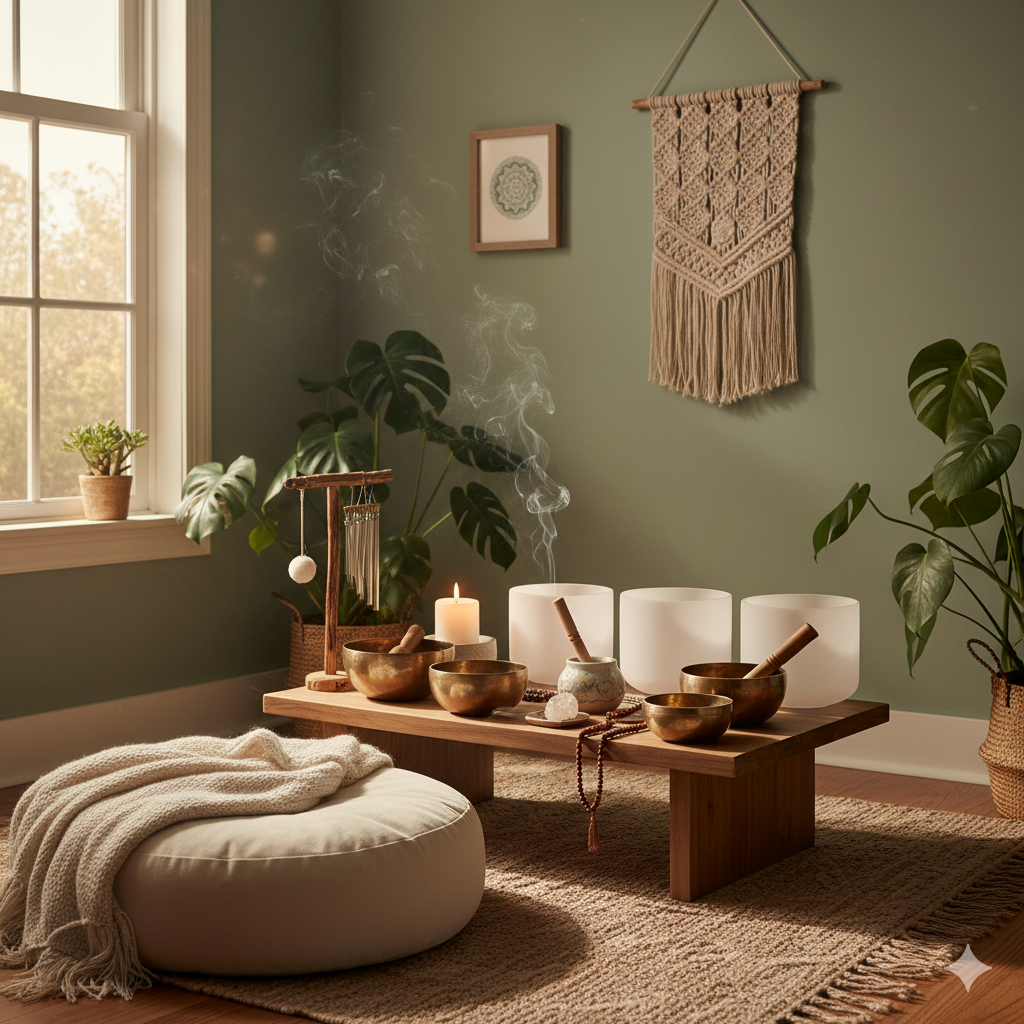
Comfort Foundation: Start with a yoga mat, meditation cushion, or comfortable chair. You'll be spending significant time here, so invest in genuine comfort. Add blankets, bolsters, and pillows as needed.
Altar or Intention Table: Create a small altar or shelf to house your sound instruments, crystals, candles, sacred objects, or anything meaningful to you. This becomes the heart of your practice space.
Lighting: Soft, adjustable lighting is ideal. Consider salt lamps, candles, or dimmable lights. Natural light during day practice can be beautiful.
Aromatherapy: Sacred scents enhance sound healing. Incense, essential oil diffusers, or smudge bundles of sage or palo santo clear energy and signal to your nervous system that it's time for practice.
Sound Insulation: If possible, add soft furnishings, curtains, and rugs to absorb sound and create a cocooned feeling. This isn't about perfect silence—it's about creating a held, sacred container.
Building Your Sound Healing Toolkit
For Absolute Beginners (Under $100)
- One singing bowl: A 6-8 inch Tibetan or crystal bowl ($40-80)
- Tingsha bells: For opening and closing practice ($15-30)
- Voice: Free! Your voice is your most portable, versatile instrument
- Recordings: Free sound healing tracks from YouTube or Spotify
Intermediate Practice ($100-300)
- 2-3 singing bowls in different notes/sizes
- A set of tuning forks (chakra set or weighted OM fork)
- Koshi chimes or wind chimes
- A simple frame drum or ocean drum
- Quality headphones for binaural beats
Advanced Practice ($300+)
- Multiple crystal and/or Tibetan bowls tuned to chakra frequencies
- Small to medium gong
- Professional tuning fork sets
- Shruti box or harmonium for drone practice
- Various percussion instruments
Remember: you don't need expensive equipment to have a powerful practice. A single bowl played with intention creates profound healing.
Fundamental Techniques to Master
Singing Bowl Technique
Striking: Hold the bowl in your flat palm. Strike the rim gently with the padded mallet. Listen deeply to the sound as it fades. This practice alone cultivates presence and mindfulness.
Rimming: After striking to "wake up" the bowl, rub the mallet around the outside rim with even pressure and consistent speed. Find the sweet spot where the bowl begins to sing continuously. This takes practice—be patient.
Advanced techniques: Try playing multiple bowls in sequence, creating sound spirals by varying speed and pressure, or placing the bowl on different parts of your body while playing.
Vocal Toning
Your voice is an incredibly powerful healing instrument. Vocal toning involves sustaining vowel sounds on a single note, creating vibration that resonates through your body.
Basic practice: Take a deep breath. On the exhale, sound a comfortable note with an open "AH" or "OM." Feel the vibration in your chest, throat, and head. Continue for several minutes.
Chakra toning: Move through the chakras using specific sounds—LAM (root), VAM (sacral), RAM (solar plexus), YAM (heart), HAM (throat), OM (third eye), and silence or NG (crown).
Tuning Fork Applications
Tuning forks create pure frequencies that can be applied to acupuncture points, chakras, or painful areas. Strike the fork on an activator or against your knee, then bring it close to or lightly touch the intended area. The precise vibrations penetrate deeply.
Creating Your Daily Practice Routine
Morning Sound Practice (10-15 minutes)
Start your day with sound to set the tone for calm, centered energy:
- Arrive and ground (2 min): Sit comfortably. Three deep breaths. Feel your connection to earth.
- Opening intention (1 min): Ring tingsha bells three times. Set an intention for your day.
- Sound clearing (3-5 min): Play your bowl, toning, or use tuning forks to clear your energy field.
- Chakra activation (3-5 min): Move awareness through each chakra with corresponding sounds.
- Closing (2 min): Silence. Integration. Gratitude. Final bell.
Evening Sound Practice (15-20 minutes)
Wind down and release the day's accumulated stress:
- Release and arrive (3 min): Conscious breathing to transition from doing to being.
- Body scan with sound (5-7 min): Play your bowl while moving awareness through your body, releasing tension.
- Emotional clearing (5-7 min): Use toning or bowl to process and release emotional residue from the day.
- Integration (3-5 min): Lie in silence, allowing healing to settle.
- Gratitude and closing: Thank yourself and your practice. Close with tingsha bells.
Weekly Deep Practice (45-60 minutes)
Once a week, gift yourself an extended session:
- Create a personal sound bath experience
- Work deeply with each chakra
- Explore vocal toning and overtone singing
- Experiment with new techniques or instruments
- Follow your intuition—let the practice flow organically
Working with Specific Intentions
For Stress and Anxiety
- Use lower-frequency bowls and drums for grounding
- Focus on root chakra frequencies
- Slow, sustained tones rather than rapid playing
- Extended silence between sounds
For Energy and Motivation
- Higher-frequency crystal bowls
- Rhythmic drumming patterns
- Solar plexus and throat chakra activation
- Uplifting toning and chanting
For Emotional Healing
- Heart chakra bowls (F note, 639 Hz)
- 528 Hz (Love Frequency)
- Allow emotional release—tears are healing
- Gentle, compassionate approach
For Sleep
- Very slow, soft playing
- Delta frequency binaural beats
- Lower chakras and grounding tones
- Practice in bed, transitioning directly to sleep
Overcoming Common Obstacles
"I Don't Have Time"
Start with just five minutes daily. Strike your bowl three times each morning. Consistency matters more than duration. Build from there.
"I'm Not Doing It Right"
There is no wrong way to practice. If you're showing up and engaging with sound intentionally, you're doing it right. Release perfectionism.
"My Mind Wanders"
That's normal and expected. Sound practice isn't about stopping thoughts—it's about returning attention to sound when you notice wandering. Each return strengthens your practice.
"I Feel Self-Conscious"
Close the door. Remember, this is your private practice. No one is listening or judging. Your voice and sounds are perfect as they are.
"Nothing Happens"
Healing works on subtle levels before becoming obvious. Trust the process. Benefits accumulate over weeks and months. Keep practicing.
Deepening Your Practice Over Time
Keep a sound journal: Track your experiences, insights, and changes. You'll be amazed looking back at where you started.
Study and learn: Read books, take workshops, learn from teachers. Deepen your understanding of sound healing principles.
Explore different traditions: Research Tibetan, Vedic, shamanic, and modern sound healing approaches. Integrate what resonates.
Share your practice: When ready, offer sound healing to friends and family. Teaching deepens your own understanding.
Join community: Connect with other practitioners online or locally. Sound healing circles amplify energy and provide support.
The Ripple Effect
As you establish your home sound practice, you're not just healing yourself—you're raising the vibration of your entire living space. Family members, pets, and even plants respond to the coherent frequencies you generate. Your practice creates a sanctuary that radiates healing energy.
Over time, your practice becomes a refuge—a reliable source of peace, clarity, and connection that supports you through life's challenges and celebrates its joys. You're cultivating a relationship with sound, with yourself, and with the universal vibrations that connect all things.
Welcome home to your sound healing practice.